
Search performance does not always improve simply because a website begins appearing for relevant keywords. A page can collect impressions without producing visits, and a service page can struggle for a query that Google is already associating with the company's homepage.
We encountered both problems while analysing the website for CleverClimb SEO Pty Ltd, our own South African SEO and web development business. This project documents how we reviewed our search data, checked the underlying page intent and used the findings to plan a more useful website content structure.
The purpose of this case study is to show the diagnostic work and the decisions it informed. It is not a claim that our forthcoming Next.js website has already improved rankings or traffic.
The challenge: Visibility without meaningful clicks
Our website was earning Google Search impressions. But when I inspected query-and-page performance, the pattern was uneven. Some commercially relevant searches were associated with the homepage; others were sending impressions to a dedicated service or pricing page far below the first page of results.
For 27 September to 24 October 2026, the query-by-page export included the following examples:
| Search query | Page shown | Impressions | Average position | Clicks |
|---|---|---|---|---|
| seo company south africa | Homepage | 409 | 13.9 | 0 |
| seo services | Homepage | 243 | 3.8 | 0 |
| seo services | SEO Services | 312 | 41.0 | 0 |
| seo packages south africa | SEO Pricing | 145 | 51.9 | 0 |
| how much does seo cost in south africa | SEO Pricing | 108 | 55.3 | 0 |
| seo company cape town | SEO Cape Town | 405 | 54.3 | 0 |
| ppc services | PPC Services | 121 | 21.3 | 0 |
These are specific query and landing-page rows, not sitewide organic totals or guaranteed search rankings. Average position changes across impressions and search contexts, and Google Search Console does not expose every query.
The surprising entry was the homepage showing an average position near 3.8 for “seo services” yet still receiving no clicks in that row. I did not assume the solution was to rewrite the meta description. It raised a diagnostic question: what kind of result were searchers seeing, on which device and in which location?
Step 1: Separate ranking problems from potential click-through problems
There is a substantial difference between a page averaging position 54 and a page averaging position 4.
For the Cape Town and pricing queries, weak visibility was the obvious immediate constraint. A persuasive description is useful, but it cannot solve a page's poor competitive positioning by itself.
For a near-top query with zero clicks, I would investigate the actual search results page, query intent, device, country and competing result features before concluding that the title or snippet was the cause. An average position is a summary statistic, rather than a fixed position on every search. Google's Search Console documentation explains why it is useful to analyse performance by query, page and country rather than trusting a headline total.
This distinction changes how work is prioritised. It keeps us from spending time on cosmetic metadata changes when the real issue may be page relevance, authority, search intent or a limited impression sample.
Step 2: Examine which page Google associates with a query
Our site had both a homepage targeting the South African market and a dedicated SEO Services page. The broad query “seo services” appeared in the data for both URLs, but with very different average positions.
That does not automatically prove keyword cannibalisation. A broad homepage and a specific service page may legitimately appear for different interpretations or contexts.
It does justify examining whether the SEO Services page answers the commercial question more clearly: what work is included, who it serves, what happens during an engagement, how technical issues are assessed and how improvements are measured. Google's SEO Starter Guide provides the foundational guidance; the question of which page should serve our particular search demand comes from our own query-by-page analysis.
The research informed content recommendations covering search diagnostics, technical and on-page work, local SEO, deliverables and realistic reporting, with clearer links between services, pricing and supporting educational material.
Step 3: Use Semrush to prioritise demand, not merely chase high volume
We compared Search Console evidence with South African keyword estimates collected during our October 2026 Semrush research. Two opportunities illustrate the value of matching demand to business intent:
- “seo company south africa” had an estimated 12,100 monthly searches with a reported organic Keyword Difficulty of 24%.
- “seo packages south africa” had an estimated 170 monthly searches with a reported Keyword Difficulty of 8%.
The larger keyword offers broader visibility potential, but “seo packages south africa” is much closer to a purchasing decision. It is also a phrase for which our live pricing page had impressions but poor average visibility.
That made the pricing page an important content priority. Instead of simply repeating SEO package names, we needed to show what the prices actually cover, why work varies between sites, and the difference between monthly optimisation and a limited once-off project.
Semrush estimates are directional research inputs; they are not our actual search traffic, projected leads or proof that a low-difficulty term will be easy to rank for.
Step 4: Review technical and on-page evidence before proposing fixes
Our public GitHub SEO case-study repository documents work from the existing website. Among its artefacts are:
- Keyword mapping and website content-architecture documents.
- Screaming Frog page-title and meta-description audit spreadsheets.
- Heading and on-page structure screenshots.
- Google indexing and XML sitemap submission screenshots.
- A NitroPack performance-optimisation dashboard record.
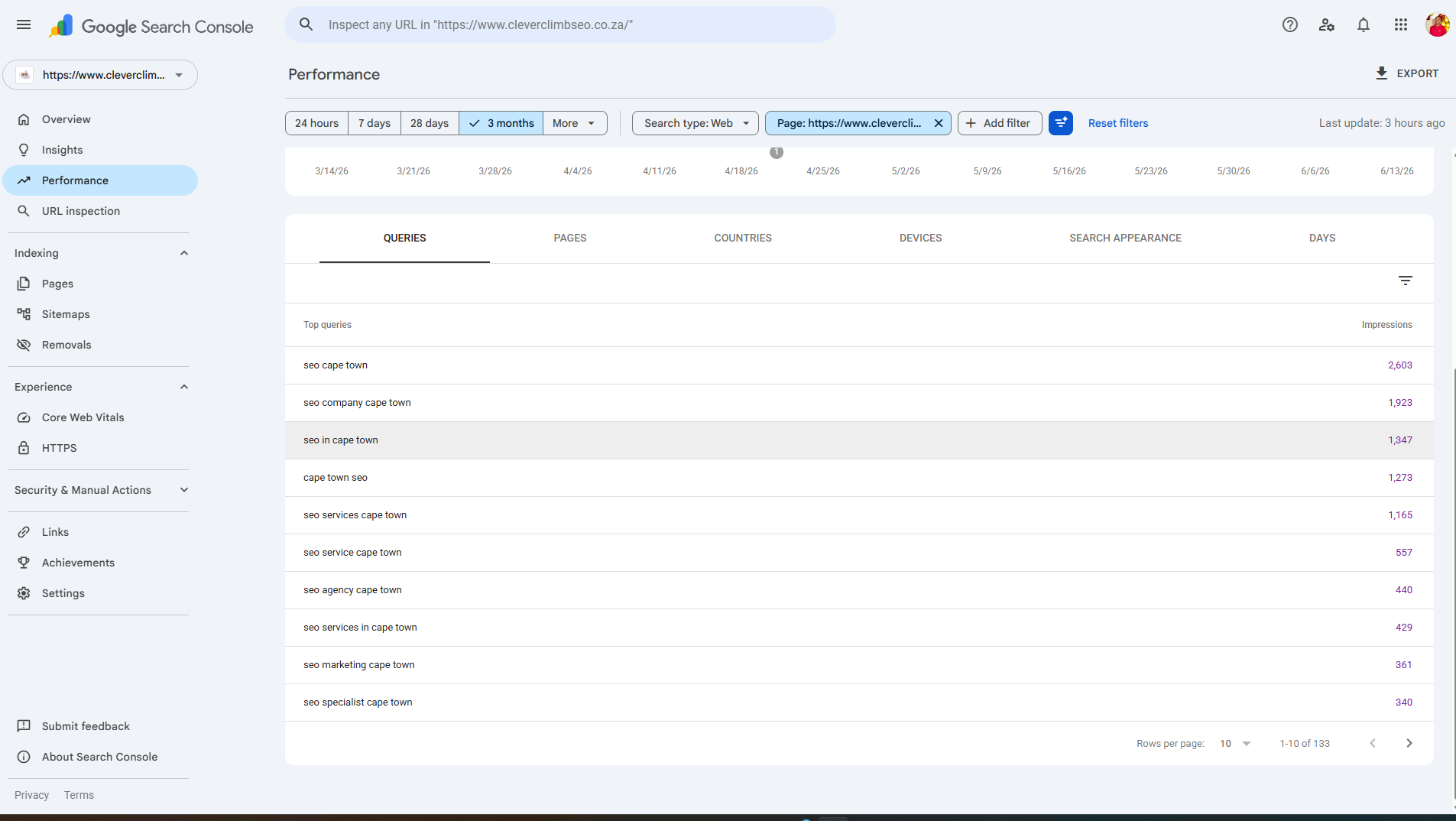
- Google Search Console query and page performance screenshots.
- WordPress/local SEO documentation, including Google Business Profile and schema-related work.
These records are useful because they allow a reader to inspect the type of work carried out, rather than relying only on a marketing claim that we “do technical SEO”.
They still require care in interpretation. An indexing screenshot does not prove good rankings. A performance dashboard is not the same as a controlled before-and-after Core Web Vitals study. A sitemap submission is not a guarantee that Google indexed every URL.
We treat each tool as evidence of a particular observation or action, not a substitute for outcome measurement.
Step 5: Map content to distinct search needs
The recommended structure gives each page a distinct purpose, supported by crawlable content and consistent navigation.
The editorial structure separates:
- The homepage: company identity, core services, trust and pathways.
- SEO Services: methods, technical/on-page/local service scope and the types of business problems addressed.
- SEO Pricing: actual package comparisons, transparent inclusions and limits.
- SEO Cape Town: genuine service relevance for that market without claiming a local office we do not have.
- Supporting guides: foundational explanations for informational intent.
- Practical articles: deeper diagnoses, such as impressions without clicks.
Clear page purposes work best within a consistent, maintainable design system.
What changed and what has not yet been proved
Documented work: Keyword research, Search Console review, WordPress SEO audits, on-page/local SEO records, content architecture and content recommendations.
Established finding: The original site earned impressions for relevant searches but often failed to earn clicks, with substantial variation in the landing page and average position.
Measurement limits: The research does not demonstrate an uplift in clicks, organic leads, rankings or revenue. Forecast improvements are not presented as achieved results.
After launch, we plan to compare the same query and page pairs, indexing state and relevant organic enquiries, while allowing for changes in demand, search position and search-result appearance. We will document the publication date and the period examined when results become available.
What this project demonstrates about our SEO approach
The main lesson is that SEO prioritisation should follow diagnosis. Impressions, clicks, ranking positions and conversions answer different questions. Search-intent mapping matters because the best page for a query may not be the page that currently receives impressions. And technical audit tools are useful only when their findings lead to proportionate, testable decisions.
At CleverClimb SEO, this is how we want to approach client work: understand the website, identify meaningful constraints, improve the pages and systems that matter, then measure changes without guaranteeing outcomes we do not control.
Technical references: Google Search Console: Getting Started · How Google generates title links · How search snippets work · Google SEO Starter Guide
Explore: SEO Services · Our public SEO research repository